
U.S. Citizens Detained Despite Valid IDs
How mass detention, mistaken arrests, and judicial intervention expose a federal strategy that governs through fear and invites future legal reckoning

Antonio Hermosillo presented his birth certificate and driver’s license. Agents detained him anyway, as if the documents meant nothing. His story is not an isolated error. It is part of a documented pattern that unfolded throughout 2025 as federal courts, civil rights attorneys, and investigative journalists revealed an enforcement system that abandoned legal restraint in favor of numerical targets. The boundary between lawful presence and unlawful detention has blurred in ways that erode the meaning of citizenship itself.
Upgrade your subscription to annual and save 20%. To paid subscribers who made this investigation possible: thank you. Without your support, this level of research would not exist. Glass Empires gains an average of one paid monthly subscriber per article, which yields six dollars after fees for articles that begin before sunrise. Annual and Vanguard members ensure this work continues.
The year brought confirmation that federal enforcement strategies were reshaped by an extraordinary daily arrest target: three thousand arrests per day. Verified reporting set up that the government measured success by volume rather than by compliance with federal law. This created an institutional environment in which officers were encouraged to detain first and verify later, even when verification should have ended the encounter. Civil rights attorneys in multiple states filed lawsuits describing warrantless home entries, street detentions without probable cause, and workplace arrests unsupported by individualized evidence. Their filings revealed that mass enforcement had become a primary aim, and that legal protections were treated as obstacles.
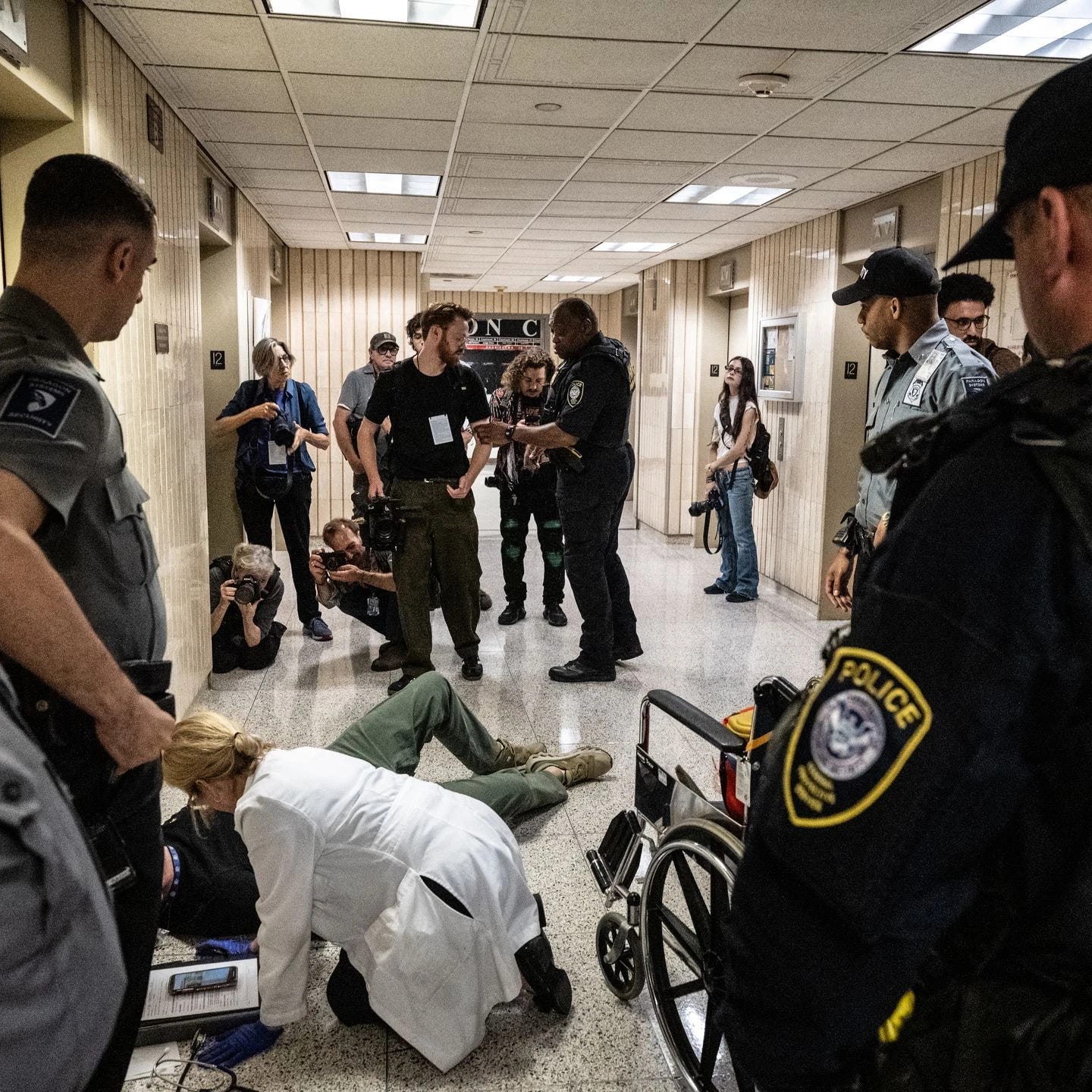
Image credit: Getty Images
The judiciary began to push back. In Chicago, a federal court examined compliance with the Castañon Nava consent decree, an agreement designed to limit warrantless arrests in the region. The court found that agents arrested individuals without the specific factual grounding required by the decree. The judge ordered the release of detainees whose arrests lacked a lawful basis. The ruling made clear that an arrest strategy driven by numbers cannot supersede the constitutional requirement of probable cause.
In the District of Columbia, a separate challenge reached a similar conclusion. Civil rights attorneys presented evidence that officers relied on reasonable suspicion as a substitute for probable cause, a standard far below what federal law requires for a warrantless civil immigration arrest. The court issued an injunction barring the agency from continuing these practices unless it could document both unlawful presence and a genuine risk of flight. The decision reaffirmed that the state may not deprive a person of liberty without a factual foundation supported by evidence.
The litigation in Colorado revealed a comparable breakdown. Plaintiffs described arrests made without warrants, without probable cause, and without adherence to statutory requirements. People were seized while traveling to work, leaving grocery stores, or standing outside their homes. Some were lawful residents. Others were United States citizens whose information had been misclassified or whose names resembled those of unrelated individuals.
These cases exposed a structural threat rather than isolated misuse of authority. Federal law requires that officers prove probable cause before making a warrantless immigration arrest, and that they believe the person may flee before a warrant can be obtained. The courts concluded that the government did not meet these requirements in a substantial number of cases. Their findings showed that essential legal safeguards were not followed, and that violations stemmed from a system shaped by pressure to achieve daily arrest quotas.
The broader social impact became visible in community behavior. Immigration attorneys reported that clients began carrying original birth certificates, passports, and naturalization papers during routine errands because ordinary identification no longer felt sufficient. Families who had lived in the United States for decades feared that a database discrepancy or misunderstanding could lead to detention. When people begin to fear that the government cannot reliably find who belongs under its protection, the meaning of citizenship fractures.

Credit: Courtesy of the Shouhed Family / ABC News
The combined record created by journalists, civil rights attorneys, and federal judges presents a national portrait of enforcement practices that exceeded their legal mandate. Reporters confirmed the existence of aggressive daily arrest quotas. Attorneys produced sworn statements and documentary evidence that officers conducted arrests without lawful justification. Judges reviewed these materials and issued findings that violations had occurred. These findings matter because they create a factual foundation that does not depend on political interpretation. They record what happened in the language of the law, where experience becomes evidence and evidence becomes the basis for future accountability.
A constitutional system depends on the consistent application of law even when political leaders encourage actions that stretch or disregard legal boundaries. The events of 2025 proved that federal institutions can become instruments of fear when incentives reward coercive tactics. Yet the same system has mechanisms that can correct those distortions. Courts can halt unlawful practices. Congress can investigate them. Prosecutors can evaluate the record once the immediate political pressures have shifted. The persistence of legal standards, even when violated, ensures that power cannot erase the evidence of its misuse.
This brings the question of responsibility into sharp focus. Federal statutes authorize the prosecution of individuals who willfully deprive people of constitutional rights under the color of law. The criminal code allows charges for conspiracies to interfere with those rights. The judiciary keeps the authority to impose criminal contempt when officials defy court orders. These statutes do not expire with the close of an administration. They stay available to future prosecutors who will review the judicial findings and decide whether officials acted with deliberate disregard for statutory limits. Civil remedies stay equally significant. Individuals who suffered unlawful detention, including United States citizens and lawful residents, may pursue claims for monetary loss, psychological harm, and reputational injury. If evidence proves a pattern of systemic misconduct that affected large numbers of people, attorneys may seek certification of a class action to secure relief on behalf of all who were injured.
What follows is the truth that corrupt power believed it could scatter in the noise of its own authority. The record created in 2025 stands beyond its reach. It preserves every violation of constitutional rights, every misuse of federal authority, and every life bent under a system that turns fear into a governing instrument. Those who endured unlawful detention have evidence that cannot be erased because it is secured in judicial findings, sworn testimony, and verified documentation that will outlast every attempt to distort what occurred.
These materials now form an unshakable platform for the prosecutors and courts who will one day decide responsibility for the harm inflicted on families and entire communities. The record has ended the refuge of denial, and its permanence ensures that the architects of these policies will face the consequences of their actions created. Fear may have shaped the present, but it will not command the future. The evidence gathered this year moves with an authority greater than the power that looked to silence it, and that authority is carrying the country toward a reckoning that corrupt power can neither delay nor escape.
Glass Empires is sponsored by readers, not advertisements. The publication gains an average of one paid monthly subscriber per article, which yields six dollars after fees. Annual and Vanguard members make this work possible. To paid subscribers: thank you. Upgrade your subscription and save 20%.
Sources
Reuters. ICE arrest targets tripled in 2025. https://www.reuters.com/world/us/ices-tactics-draw-criticism-it-triples-daily-arrest-targets-2025-06-10
American Civil Liberties Union of Colorado. Ramirez Ovando v Noem filings. https://www.aclu-co.org/app/uploads/2025/10/20251009-No.-1-Complaint.pdf
American Civil Liberties Union of Colorado. Press release on unlawful warrantless arrests. https://www.aclu-co.org/press-releases/immigrant-rights-advocates-sue-trump-administration-over-ices-unlawful-warrantless-arrests
American Civil Liberties Union of the District of Columbia. Escobar Molina v DHS injunction. https://www.acludc.org/press-releases/federal-judge-blocks-unlawful-immigration-arrests-in-washington-d-c
National Immigrant Justice Center. Federal judge orders release of detainees in Chicago. https://immigrantjustice.org/press-release/federal-judge-in-chicago-orders-ice-to-release-hundreds-of-people-from-detention-centers-who-were-arrested-in-likely-violation-of-consent-decree
ABC7 Chicago. Coverage of unlawful Chicago area arrests. https://abc7chicago.com/post/chicago-immigration-enforcement-warrantless-arrests-ice-agents-area-ruled-unlawful-federal-judge/17967144
American Immigration Council. Reports on wrongful detentions and enforcement patterns. https://www.americanimmigrationcouncil.org/blog
Valverde Law. Documented detentions of United States citizens in 2025. https://www.valverdelaw.com/more-than-170-u-s-citizens-detained-by-ice-so-far-in-2025
The purpose of Trump's degradation of foreigners is to make "others" not want to be here. As I wrote and posted in October, "I AM OTHER" and this should be what unites us. Not by race, ethnicity, religion, socioeconomic status, but by what "other" means. As I wrote, I know what category I am, and I am going to wear it proudly because being "other" means that I am not "them." Being "other" means that I am not complicit to hate, dereliction of duty, or fascism. Because, as the Nobel Laureate Maria Ressa has said, "silence is complicity because silence is consent." Well, I am not silent, and I do not consent. mariochavez.substack.com/p/I-Can-proudly-Say-That-I-Am-OTHER
My husband and I are both second generation US citizens, both Air Force veterans, I am a civil service retiree. We both carry a copy of ALL our identifying papers with us at all times, because this is a lawless regime attacking its own citizens.