
The Mob Boss Training Program
How American Television Prepared Voters for Trump

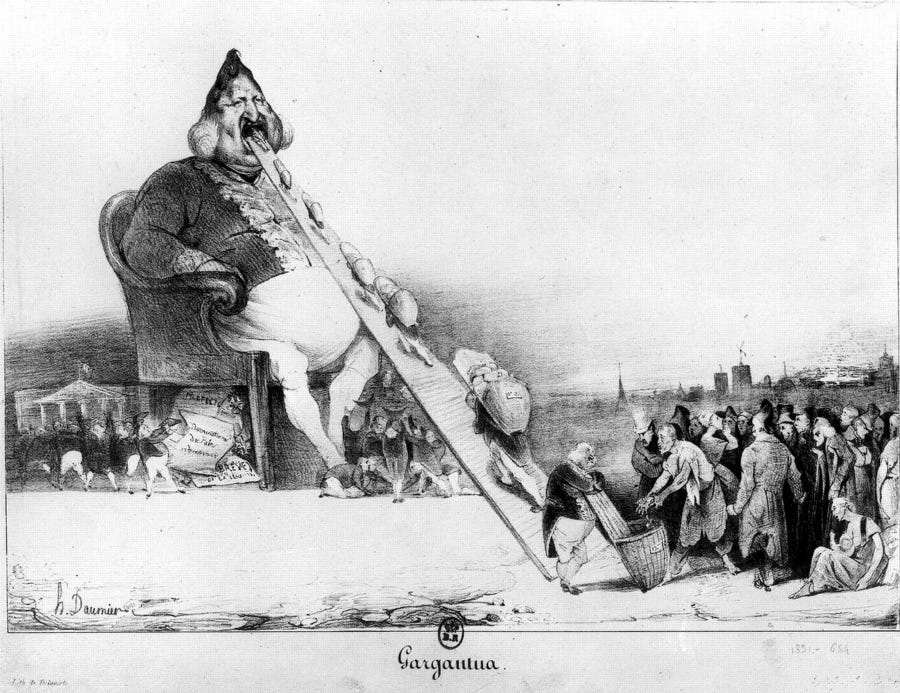
Artwork: Honoré Daumier, The Legislative Belly (1834). Daumier portrayed political authority as a grotesque congregation of corruption, appetite, and loyalty protecting power. Two centuries later the image reads like a portrait of mob style rule normalized through culture, where allegiance to the boss governs the room.
“Life imitates Art far more than Art imitates Life.” — Oscar Wilde, The Decay of Lying, 1889
A convicted felon occupies the presidency, having funneled $10 billion in taxpayer money into a sham Board of Peace, launched a war without congressional authorization, and handed the Department of Justice to loyal appointees now burying evidence of rapes committed against 13-year-old girls.
All of this happened inside a single month in 2026, and the country did not flinch. That absence of outrage is the subject of this piece.
This publication runs without a paywall, advertisements, or corporate backing. Every investigation comes entirely from paid members like you. Annual memberships are 40% below the monthly rate and that window closes soon.
America did not arrive here suddenly. For half a century, American television taught audiences that mob bosses were villains and detectives were heroes. Lawmen represented order while criminals embodied intimidation, and institutions reliably defeated organized crime.
Then the camera angle shifted and television moved inside the mob, examining the psychology of the boss rather than the criminal. When a political figure speaking the language of loyalty and retaliation entered national politics, the country already recognized the character.
The Western planted that moral grammar first. Cultural mythologist Joseph Campbell observed that societies interpret leadership through recurring symbolic archetypes: the sheriff, the outlaw, the warlord, the ruler, templates repeated across generations until they become the lens through which power gets recognized.
The genre built a mythology around the armed individual as the final barrier between order and chaos. The gun anchored that narrative. Frontier justice rested on a single figure acting on conviction and drawing before any institution could intervene.
That romanticism settled into a reflexive national narrative, and when Ronald Reagan moved from film sets to the California governor’s office and then to the White House, he carried that aesthetic into every policy decision. The lawman who never needed to answer to anyone had become an electoral brand.
Police dramas of the 1960s and 1970s reinforced that structure. Series such as Starsky and Hutch and Hawaii Five-O built stories around investigators confronting organized crime and restoring order through discipline, evidence, and procedure. Authority rested with the badge rather than the criminal. The mob boss served as the destabilizing force and usually ended the story arrested, dead, or imprisoned.
The detective genre carried a harder edge than the Western and entered terrain Westerns rarely explored. Heroism required examining power from within rather than deferring to authority. Every strong detective story returned to the same question: who inside the system protects the criminal?
That logic extended into gangster films. In Scarface, Tony Montana rises through intimidation before dying in a final barrage of gunfire. The empire shatters and order returns.
A voter conditioned to distrust the precinct captain stands only a short distance from distrusting the election official and the federal judge. A population shaped by that suspicion becomes receptive to a leader who weaponizes grievance and directs anger toward democratic institutions.
The Watergate crisis mirrored the moral architecture of the police dramas already dominating television. Presidential criminality unfolded on national television, yet the investigation followed the same procedural path audiences had watched for years. Evidence accumulated. Investigators pressed forward and institutions forced accountability. The scandal confirmed the narrative logic of shows such as Hawaii Five-O: corruption could reach the highest office, yet disciplined investigation and legal process could still bring power to heel.
By the end of the twentieth century television abandoned that perspective. Prestige drama moved the camera away from investigators and into the command structure of criminal power. Series such as The Sopranos, Breaking Bad, Narcos, Ozark, and Peaky Blinders built narrative momentum around figures operating outside civic authority while exercising dominance that resembled governance.
Tony Soprano commands a network of patronage and fear in New Jersey. Walter White constructs an empire through calculation and ruthlessness. Pablo Escobar rules territory through violence and charisma, and Tommy Shelby consolidates authority through discipline and brutality. Prestige television moved viewers inside the strategic world of the crime boss.
Psychologist Albert Bandura established that repeated exposure to powerful figures who achieve status enables audiences to internalize their behavioral patterns. Media scholar George Gerbner went further, demonstrating through cultivation theory that long-term television viewing does not merely entertain but rewrites the viewer’s perception of social reality.
Hundreds of hours of storytelling in which powerful figures command loyalty and punish rivals gradually reshape what leadership looks like. Defiance acquires the aura of strength while procedural restraint looks like weakness.
The Hunger Games, The Handmaid’s Tale, and Black Mirror extended that trajectory by portraying societies where domination moves beyond criminal organizations and embeds within systems of control. Surveillance replaces secrecy and cruel dominance displaces accountability.
The Apprentice added another cultural layer, staging Trump as a boss whose authority rested on personal judgment and public humiliation. Each episode ended with ritualized dismissal, subordinates measured for loyalty before hearing the verdict.
Trump entered national politics through that media environment. The persona projected invulnerability while the governing style mirrored mob cruelty, power enforced through loyalty tests and retaliation against dissent.
“When you’re a star,” he told an interviewer in 2005, “they let you do it.” The line exposed the operating rule behind mob power: domination as justification and immunity claimed as the reward of power.
Mob leadership runs on two rules: loyalty above law and retaliation against dissent, enforced through public displays of dominance that reward followers and intimidate rivals.
Trump advanced that model through calculated ambiguity and relentless threat. Targets were named in public, pressure amplified through speeches and posts, and intimidation followed without a direct order. Prosecutors, election workers, federal witnesses, and journalists encountered the same pattern: exposure, harassment, and threats that bent daily life around fear. Researchers describe the tactic as stochastic terrorism, rhetoric that singles out individuals until violence becomes likely while the speaker maintains distance.
Loyalty became the currency of power. Officials received praise for allegiance and punishment for independence. Investigations were recast as enemy plots and witch-hunts. Threats against critics, prosecutors, and reporters drew approval, while supporters praised the behavior as proof that “he tells it like it is.”
A jury finding of sexual abuse, federal indictments tied to election interference, criminal charges over classified documents, and civil judgments for financial fraud created a legal landscape in which he repeatedly collided with law enforcement while his base remained loyal. A culture steeped in decades of mob narratives recognized the pattern and treated confrontation with the law as proof of strength. On the campaign trail he framed the role plainly: “I am your retribution,” a line that echoed the mob bosses television had spent decades teaching audiences to recognize.
They’re not after me. They’re after you. I’m just standing in the way. — Donald Trump
The same logic carried into wartime. During the 2026 conflict with Iran, Trump accused major American news organizations of spreading enemy propaganda and warned that critics could face treason charges. Federal Communications Commission chairman Brendan Carr signaled that television networks could face license review if coverage diverged from the administration’s narrative. Trump praised those threats and branded journalists collaborators with hostile forces.
In August 2023, the Fulton County Sheriff’s Office released Donald Trump’s booking photograph following criminal charges connected to attempts to overturn the 2020 election. Trump posted the image on social media with a single caption: “NEVER SURRENDER!” Within 24 hours, his campaign reported raising $7.1 million. A moment of legal accountability had been converted into a war cry and a revenue stream.
“Al Capone was one of the greatest of all time… but he was treated much better than me.” — Donald Trump, 2024 campaign rally
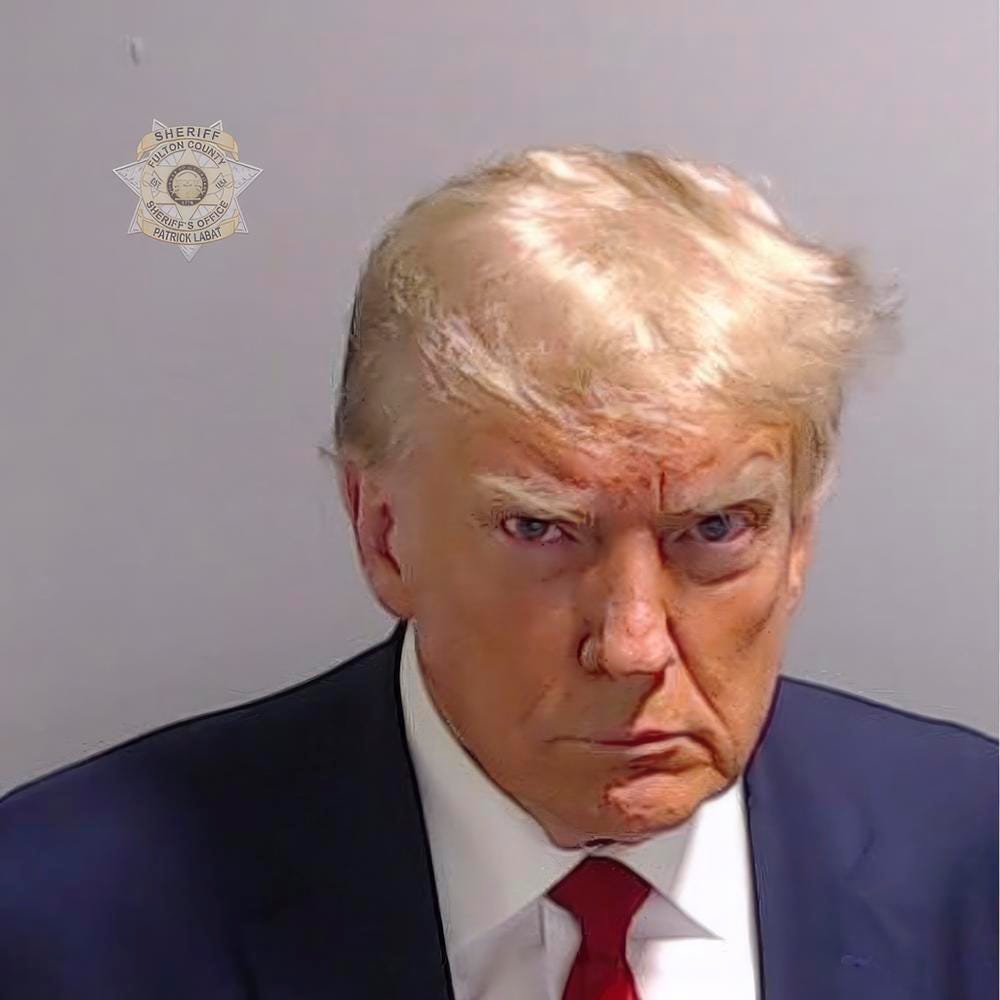
Photograph: Fulton County Sheriff’s Office booking photograph of Donald J. Trump, taken August 24, 2023, at the Fulton County Jail in Atlanta, Georgia, following indictment related to efforts to overturn the 2020 election. The image traveled globally and was quickly embraced by his campaign as a symbol of defiance, the expression and staging echoing the familiar visual grammar of mob boss mythology.
For most of the twentieth century, a booking photograph signified the triumph of civic structures over criminal power. Cultural conditioning shaped by decades of stories featuring charismatic outlaws confronting hostile systems had corroded that reading entirely. The image resembled a scene audiences had absorbed across thirty years of prestige television: a defiant boss staring down the machinery sent to break the operation apart.
A society that once celebrated the lawman had learned to recognize power in the figure who stands outside the law while commanding allegiance within his circle.
Oscar Wilde wrote that life imitates art far more than art imitates life. The Hunger Games imagined a ruling class staging suffering as entertainment, demanding loyalty from impoverished districts, and punishing dissent through spectacle that reminded the population who controlled the narrative. During a federal shutdown, Trump hosted a glittering gala at Mar-a-Lago while large parts of the government sat frozen and hundreds of thousands of workers went unpaid, a display of domination through performance. The Capitol governed through theater, and theater enforced power. The cruelty was the point.
The Board of Peace is a political creation. Treason accusations aimed at journalists are threats. The $7.1 million raised from a booking photograph became campaign money. Fiction arrived first. The country absorbed the logic long before reality enforced the outcome.
America did not suddenly embrace mob governance. Television spent decades conditioning audiences to watch powerful figures confront institutions, absorb legal blows, and survive through force of personality. The script already existed when that figure entered national politics. Millions recognized the boss on sight.
The show is still running. The only question is whether the audience demands a different ending or keeps watching until the screen goes dark.
This publication runs without a paywall, advertisements, or corporate backing. Three% of readers fund the work the other 97% read free which is not sustainable. Every investigation carries real costs in time, research, and resources that come entirely from me and paid members. Annual memberships are 40% below the monthly rate and that window closes soon.
Sources
Bandura, Albert. Social Learning Theory. Prentice Hall. 1977.
Gerbner, George. “Cultivation Theory and Television Effects.” University of Pennsylvania Annenberg School for Communication. 1969.
Campbell, Joseph. The Hero with a Thousand Faces. Princeton University Press. 1949.
Chase, David, creator. The Sopranos. HBO. 1999 to 2007.
Gilligan, Vince, creator. Breaking Bad. AMC. 2008 to 2013.
Burnett, Mark, creator. The Apprentice. NBC. 2004 to 2017.
Fulton County Sheriff’s Office. Booking Photograph of Donald J. Trump. August 24, 2023.
Trump, Donald. Access Hollywood Recording. September 2005.
Trump, Donald. Post on X. August 24, 2023.
Trump, Donald. Remarks Calling for Treason Prosecutions of War Opponents. 2026.
The only thing lower than accepting immoral leadership is aiding (quietly or loudly) immorality against others.
Cruelty is the point of this regime. It's disgusting.